
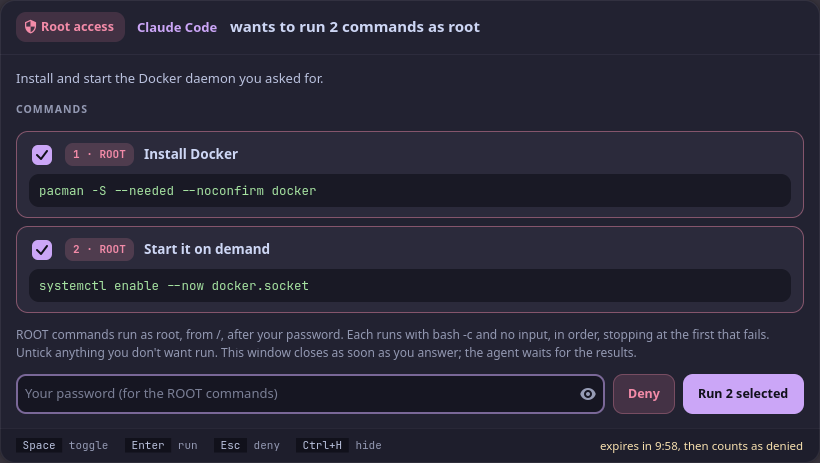
Dvarapala (द्वारपाल) is Sanskrit for "permission, consent": nothing runs as root without yours.
An AI coding agent (Claude Code, Codex, Aider, Gemini CLI, anything that can run a shell command or speak MCP) regularly needs something done as root: install a package, enable a service, edit a file in /etc. The usual answer is to copy sudo commands between the agent and a terminal. dvarapala replaces that: the agent sends the commands, each with a reason; a window shows them on your desktop; you untick what you don't want, type your password once, and the ticked commands run. The agent gets every command's output and exit code back.
The same goes for commands that don't need root but that the agent can't run itself: its sandbox blocks the network or a folder, or you've set it to ask first. The agent marks those "as": "user"; they show in the same window with a YOU badge instead of ROOT, run as you with a click (no password), and come back the same way.
#Features
- You see exactly what runs: every command as it will run, under the agent's one-line reason for it, and a checkbox on each.
- Root or you, never mixed up: every command carries a ROOT (red) or YOU badge and its number in the run order; YOU commands also show the user and folder they run in. The password is asked for only when a ROOT command is ticked (ADR 8).
- One password for the batch, typed into a window the agent didn't start and can't read. No sudo timestamp is left behind (
sudo -k). - Structured results: per-command state (
ok,failed,skipped,declined), exit code, stdout and stderr, as JSON on stdout, with meaningful exit codes. - Two ways in: JSON on stdin (or
--cmd/--whypairs) for anything that runs shell commands, and an MCP server (--mcp) with one tool,request_commands(also under its old name,request_root_commands). - Refuses tricks: requests with control characters or invisible Unicode (bidi overrides, zero-width) are rejected, so what you read is what runs; every command needs a reason; at most 50 per request.
- Audit trail: a root-only log of everything that ran, and your own log of every request, denied ones included.
- Expires: an unanswered request counts as denied after 10 minutes.
- Answer from your phone: with ekatva running, the request also shows on your paired phone; approving there (your fingerprint, your password) is the same as typing it here (ADR 7).
#Install
Requirements: Linux with a Wayland desktop (sway, Hyprland, GNOME, KDE…) and systemd's user manager, sudo, Python 3.11+, PyGObject, GTK 4, libadwaita, and libnotify (notify-send).
git clone https://github.com/Theyashsawarkar/dvarapala ~/.local/share/dvarapala
~/.local/share/dvarapala/install.sh          # asks for sudo once
dvarapala --why "Test" --cmd "id"            # the window opens; approve it
install.sh installs everything root-owned (/usr/local/bin/dvarapala, /usr/local/lib/dvarapala/), so an agent running as your user can't change what the window shows or what it runs. On Arch it installs the dependencies too; elsewhere install them first (Debian/Ubuntu: python3-gi gir1.2-gtk-4.0 gir1.2-adw-1 libnotify-bin; Fedora: python3-gobject gtk4 libadwaita libnotify).
~/.local/share/dvarapala/install.sh --check       # what differs from this clone
git -C ~/.local/share/dvarapala pull && ~/.local/share/dvarapala/install.sh   # update
~/.local/share/dvarapala/install.sh --uninstall
It used to be called vayu-elevate; the installer keeps that name as a link to dvarapala, so agents and notes that still use it keep working.
#What you see
A window opens with everything the agent asked for: each command exactly as it will run, its reason, a checkbox, and a badge saying how it runs: ROOT (as root, from /) or YOU (as you, in the folder shown under it). The top bar says how many of each. Untick anything you don't want, type your password if any ROOT command is ticked, press Run (or Enter). A request with only YOU commands has no password field. The window closes the moment you've answered (after a right password, if one was needed) and you're done: the ticked commands run on without it, in order, stopping at the first failure, and it's the agent that waits for the results, failures included (ADR 9).
It looks like the rest of the desktop: Vyom's panels, in your varna theme when you have one. The theme's colours are used only if everything stays readable (see Security), so a theme can change tints, never hide anything.
| Key | Action |
|---|---|
Enter (password field or Run) | Run the selected commands (as root and as you) |
Space | Toggle the focused command |
Esc | Cancel the root request (deny everything) |
Ctrl+H | Hide the approval window (unanswered, the request stays open on the phone until it expires) |
Closing the window, Deny or Esc means nothing runs. Three wrong passwords end the request. A request nobody answers expires after 10 minutes.
#For agents: sending a request
Send a JSON request on stdin. It blocks until the user answers (up to 10 minutes), then prints a JSON result.
dvarapala <<'EOF'
{
  "requester": "Claude Code",
  "reason": "Install Docker and start it on demand, as you asked.",
  "commands": [
    {"cmd": "pacman -S --needed --noconfirm docker", "why": "Install Docker"},
    {"cmd": "systemctl enable --now docker.socket", "why": "Start Docker when something connects to it"},
    {"cmd": "docker compose up -d", "why": "Start the project's services",
     "as": "user", "cwd": "/home/me/project"}
  ]
}
EOF
One-off form: dvarapala --requester "Claude Code" --why "Reload udev rules" --cmd "udevadm control --reload" (repeat --why/--cmd pairs for more; add --as user and --cwd DIR to run them all as you). dvarapala --schema prints the request and result JSON Schema.
Rules for the commands:
"as"says how each runs, and the user sees it on the card:"root"(the default, so 1.x requests work unchanged): as root, from/. Needs the user's password.cwdisn't allowed."user": as the user, incwd(an absolute path; default: their home), approved with a click. For commands that don't need root but that you can't run yourself (a sandbox, a permission rule). They run outside your sandbox, from the window, with the session's environment filtered to an allowlist (HOME,USER,LANG,PATHwithout world-writable folders, the Wayland/D-Bus/SSH-agent sockets…), not yours: pass anything else on the command line.
- Each runs with
bash -c, with no stdin and no tty: anything that prompts fails or hangs until its 30-minute limit. Usepacman --noconfirm,apt -y,cp -fand the like. - They run in order and stop at the first non-zero exit; the rest are reported as
skipped. - Every command needs a
why: one plain line the user decides from. - At most 50 commands, 8000 characters each; no control characters or invisible Unicode.
- In a ROOT command
~is root's home: write/home/<user>/...in full.
Ask for exactly what's needed, explain each command honestly, don't re-send a denied request unless the user asks, and treat a declined command as the user's answer.
#For agents: reading the result
{
  "status": "completed",
  "message": "Ran the approved commands.",
  "approved": [0, 1],
  "declined": [],
  "results": [
    {"index": 0, "command": "pacman -S --needed --noconfirm docker", "why": "Install Docker",
     "as": "root", "cwd": "/", "decision": "approved", "state": "ok", "exit_code": 0, "stdout": "...", "stderr": "",
     "duration": 14.2, "timed_out": false, "truncated": false}
  ]
}
status | Meaning |
|---|---|
completed | At least one command was approved and they ran: check each result's state |
denied | The user pressed Deny, Esc or closed the window; nothing ran |
timeout | No answer within 10 minutes; nothing ran |
auth_failed | Wrong password three times; nothing ran |
error | Bad request or the tool itself failed; see message |
state | Meaning |
|---|---|
ok | Ran, exit code 0 |
failed | Ran, non-zero exit code |
skipped | Approved, but an earlier command failed |
declined | The user unticked it |
not_run | The request was denied, timed out or failed before running |
Output is capped at 512 KB per stream (truncated: true when cut).
| Exit code | Meaning |
|---|---|
0 | Every command was approved and succeeded |
1 | An approved command failed |
2 | Bad request or tool error |
3 | Nothing ran (denied, timeout, wrong password) |
4 | Some commands were declined; the approved ones succeeded |
#For agents: over MCP
dvarapala --mcp is an MCP server (stdio) with one tool, request_commands, taking the same request object and returning the result as text and structuredContent. It's also listed under its 1.x name, request_root_commands (the same tool: commands without "as" run as root), so existing setups keep working.
claude mcp add --scope user dvarapala -- dvarapala --mcp # Claude Code{
"mcpServers": {
"dvarapala": {"command": "/usr/local/bin/dvarapala", "args": ["--mcp"]}
}
}The call blocks until the user answers (up to 10 minutes) and the approved commands finish; the window itself closes as soon as the user answers. If your client times out tool calls sooner, raise its limit (Claude Code: the MCP_TOOL_TIMEOUT environment variable, in milliseconds).
#Telling your agent about it
Add a few lines to the agent's global instructions (Claude Code: ~/.claude/CLAUDE.md; Codex: ~/.codex/AGENTS.md; Gemini CLI: ~/.gemini/GEMINI.md):
- Commands you can't run yourself: don't ask me to paste them into a
  terminal. Send them to `dvarapala` (JSON on stdin: requester, reason,
  commands: [{cmd, why, as, cwd}]; see `dvarapala --help`): `"as": "root"`
  for anything that needs root, `"as": "user"` (with `cwd`) for the rest,
  like a command your sandbox blocks. I approve them in a window; you get
  the results. Respect declined commands; never retry a denied request
unasked.#What's recorded
Every command that ran as root, with its exit code, goes to /var/log/dvarapala.log: root-only, so the agent can't edit it. Every request, denied ones included, goes to your own ~/.local/state/dvarapala/requests.jsonl, with each command's as and cwd (YOU commands are only in this one).
sudo tail -n 20 /var/log/dvarapala.log | jq .
tail -n 5 ~/.local/state/dvarapala/requests.jsonl | jq .#Security
dvarapala is a consent gate: nothing runs as root unless you see it and type your password, and nothing runs as you unless you see it and press Run.
| Guarantee | How |
|---|---|
| The agent never sees your password | It's typed into the approval window: a separate process the agent didn't start (a transient systemd user service, with a clean environment) and can't inspect (PR_SET_DUMPABLE=0). |
| What runs is what you saw | The window and the root-side runner are root-owned files; the window holds the request in memory once shown; Python runs isolated (-I); your GTK styling can't hide part of it (the window uses root-owned XDG dirs); the theme's colours are read as plain #rrggbb only and used only while every text stays readable, else dvarapala's own (ADR 6); invisible or direction-changing characters are refused. |
| No leftover access | sudo runs with -k both times: no cached credentials for anything else. |
| ROOT and YOU can't be confused | Each card says which, in its own colour, with its number in the run order; YOU cards show the user and folder. A command without "as" is ROOT, never the reverse; root commands always run from /. |
| A YOU command runs only what you saw | It runs from the window, not the agent, with bash -c (no login shell, so no rc file), in an allowlisted environment taken from the session's systemd user manager, not the agent: no BASH_ENV, LD_PRELOAD or exported functions, and a PATH without relative or world-writable folders (ADR 8). |
| Answering from the phone changes none of this | The phone's answer, through ekatva's end-to-end encrypted link, ticks the commands visibly and fills the password field; then the same check and runner. The window sends nothing secret out, and finds ekatva by your uid, not the agent's environment (ADR 7). |
What it can't do: protect you from a program that is actively malicious and already running as your user. Such a program could draw a lookalike window to collect your password, or tamper with the systemd user manager the window starts from; that's true of every password prompt on a Linux desktop, polkit's included. Use dvarapala with agents you trust to ask honestly, and read each command before you approve it. Report security problems privately: SECURITY.md.
#How it works
dvarapalarejects bad requests (nowhy, more than 50 commands, hidden characters), writes the request to$XDG_RUNTIME_DIR/dvarapala/<id>/(mode 0700) and starts the window withsystemd-run --userandenv -i: a transient service, not a child of the agent.- The window (
lib/dialog.py, GTK 4 / libadwaita) reads the request once into memory and shows it. You untick, type your password, press Run. - If a ROOT command is ticked, it checks the password with
sudo -S -k true. Then the window hides (the process stays, with no window) and it goes through the ticked commands in order: each run of consecutive ROOT commands goes tosudo -S -k -- python3 -I runner.py, with the password and those commands on its stdin (nothing is written to disk); each YOU command runs in the window's own process (lib/userrun.py). - The runner (
lib/runner.py) runs each command withbash -cfrom/, no stdin, a minimal environment, 30 minutes max each, and appends each to/var/log/dvarapala.log. YOU commands get the same limits. The first failure, either kind, skips the rest. - The process writes
result.jsonand exits;dvarapalaprints it and exits.
#Troubleshooting
- The window closed but the agent is still waiting. That's normal: the window goes when you answer, and the agent waits for the commands to finish.
systemctl --user list-units 'dvarapala-*'shows a run or a hidden request still going. A hidden request nobody answers ends after 10 minutes, as denied. - No window appears. dvarapala needs a graphical session:
WAYLAND_DISPLAY(orDISPLAY) and systemd's user manager. From SSH or a plain TTY it returnsstatus: error. - "Wrong password" though it's right. Your user must be allowed to use
sudo(thewheelgroup on Arch,sudoon Debian). - A command hangs, then times out. It's waiting for input: add a non-interactive flag (
--noconfirm,-y). - The window looks unstyled or tiny. Install libadwaita; on a tiling compositor, float it: sway
for_window [app_id="^io\.github\.theyashsawarkar\.Dvarapala$"] floating enable.
#Contributing
Bug reports, ideas and pull requests are welcome: see CONTRIBUTING.md, and CHANGELOG.md for what changed in each release. Changes to what runs as root get extra scrutiny; security reports go privately (SECURITY.md).
dvarapala comes from Vayu, a keyboard-driven Wayland desktop, and works on any Linux desktop on its own.